Buy Now, Pay Later for Groceries: A Warning Sign? | My Debt Navigator
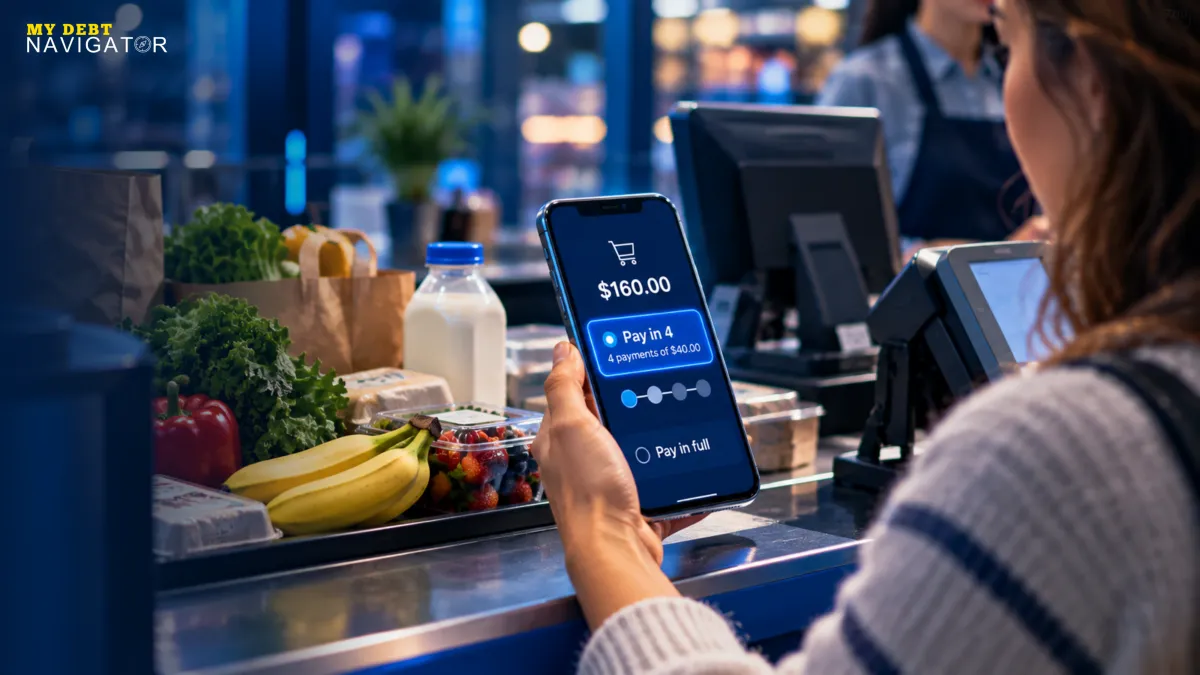
A $160 grocery bill appears on the checkout screen. Beside the full amount is another option: four payments of $40. Rent is due this week, and the smaller number is tempting. The remaining $120 will come from later paychecks. On a common pay-in-four plan, three payments follow at two-week intervals, although terms vary. (Source: Consumer Financial Protection Bureau)
By the next grocery trip, much of that food may be gone while its payments remain. Using buy now, pay later for groceries can be a warning sign when new trips repeatedly need financing while earlier ones are still being paid. A single purchase tells us little about a household’s finances. The next two paychecks tell us more.
What grocery BNPL use can reveal
The Federal Reserve’s 2025 household survey found that one in five buy now, pay later (BNPL) users had used it for groceries or food delivery in the prior 12 months. Those categories are combined in the survey. Among users who bought either, 45% said their main reason for using BNPL was that it was the only way they could afford a purchase. That does not establish why any particular shopper chose installments. (Source: Federal Reserve)
A shopper with $160 already set aside might prefer installments because the payment dates suit their budget. Another may need the $120 left in the bank today to cover a bill tomorrow. Both see the same offer at checkout. The difference becomes visible after the purchase, when the next grocery bill and earlier installments compete for the same income.
When three $40 payments meet one paycheck
Imagine three active $160 grocery plans. Each has a $40 installment due in the same pay period, so $120 of that paycheck goes toward food already bought. That is possible even when every payment is on time. Actual schedules depend on the plans.
Consider a hypothetical $900 paycheck. After $500 rent, $100 utilities, $90 transportation, and $120 in installments, $90 remains. A $160 grocery trip leaves a $70 gap. Another pay-in-four plan could cover today’s checkout and add payments to later paychecks.
That $70 gap is easy to miss at checkout. An app may show dates for its own provider, so check other providers’ apps and confirmation emails too. The rent and utility bills need a place on the same calendar. Someone can be current on every account and still reach the store with too little available for food.
A missed installment can add costs. The Consumer Financial Protection Bureau says BNPL lenders may charge late fees, while an automatic payment from an account without enough funds may trigger an overdraft or insufficient-funds fee from the bank. Lender and bank terms vary. (Source: Consumer Financial Protection Bureau)
What the next two paychecks can tell you
Place every remaining installment beside expected take-home pay, essential bills, and other debt payments for the next two pay periods. Add groceries that will need to be purchased before each following payday. If your income varies, use an amount you can reasonably expect rather than your best recent paycheck.
Now look at the money left in each period. If the next grocery trip and essential bills still fit after the installments are counted, the immediate cash-flow picture is less strained. A shortfall calls for one more check: will it disappear when an unusual expense or existing plan ends? Needing another grocery plan while earlier ones remain open may signal a gap that repeats. Each new plan then puts another claim on income needed for the next round of essentials.
If pay arrives shortly after a bill is due, ask whether that creditor allows the date to be moved. When the income for the entire period remains too low to cover necessities and payments, changing the date moves the shortage around the calendar. The two-paycheck view makes that distinction easier to see.
When the gap keeps returning
Start with the amount missing each pay period, then review recurring charges and bills that may be reduced. Contact a creditor before a payment is missed to ask about available options. If credit cards or loans are adding to the pressure, compare any consolidation offer by its total cost and repayment length as well as its monthly payment. A lower payment may result from taking longer to repay. (Source: Consumer Financial Protection Bureau)
My Debt Navigator’s guide to signs that debt is becoming difficult to manage looks at pressure across several obligations. When BNPL sits alongside credit cards, personal loans, or medical bills, you can request a free, no-obligation consultation with My Debt Navigator to discuss possible debt-related options. MDN is a referral affiliate that may connect consumers with independent providers; it does not directly provide debt settlement. Eligibility and outcomes vary.
At the next checkout, the question is how much of the next paycheck is already promised to groceries bought weeks ago.
Book a free consultation call with My Debt Navigator.
This article is for general education and is not individualized financial advice.